
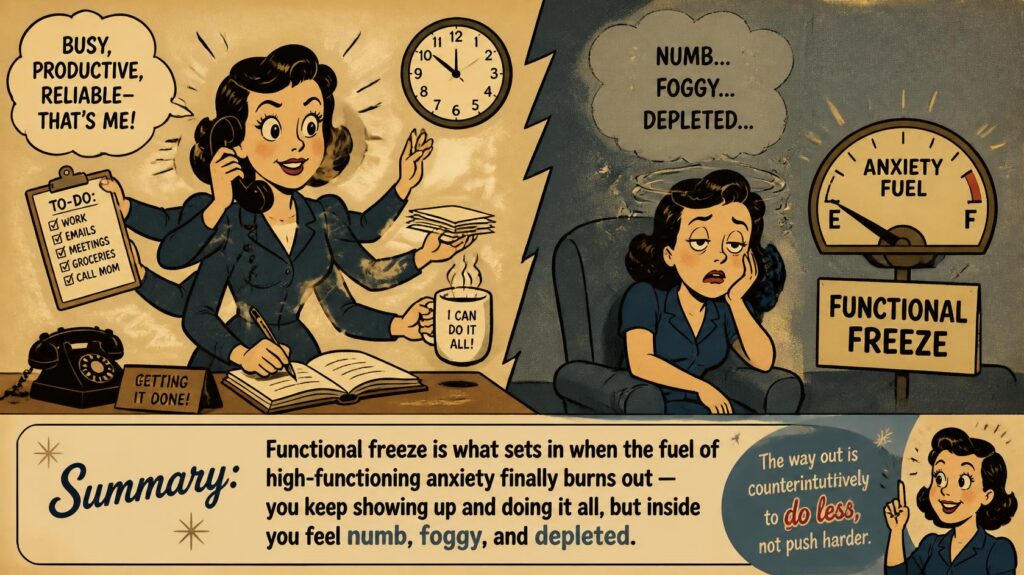
Summary: Functional freeze is what sets in when the fuel of high-functioning anxiety finally burns out — you keep showing up and doing it all, but inside you feel numb, foggy, and depleted, and the way out is counterintuitively to do less, not push harder.
Key Points:
1.) It’s not laziness. It’s an involuntary nervous-system shutdown that builds gradually in stages, which is why it’s so hard to catch. You still look “functional” while it takes everything to manage the basics.
2.) Pushing harder is the trap. Self-criticism signals more threat and deepens the freeze. Recovery starts by naming it and removing things from your load, not adding more.
3.) Regulate the body before the mind. Walking, body scans, and low-stimulation environments beat thinking your way out. Pair that with shrinking tasks, outsourcing without guilt, and easing the false urgency.
If you’ve read my blog about high-functioning anxiety, you might also be curious about what happens when the fuel of anxiety burns out, and we can no longer rely on it to keep us going. Introducing: the functional freeze response. At first glance, and from an outsider’s perspective, things may not look that different. But for you, the one experiencing this freeze response, your internal world may feel unrecognizable.
Functional freeze is a nervous system state we slide into when our bodies are run ragged from managing it all. It is our nervous system’s way of trying to signal to us that we just can’t continue at the rate and pace we’ve been going. Our body slows and moves toward shutdown as both an energy-conserving mechanism and to protect us from completely burning out. Outwardly, we may still appear productive, but inside, we may be wrestling with feeling disconnected, numb, stuck, or overwhelmed.
Here’s What to Look Out For
- You struggle to start non-urgent tasks or make decisions
- You feel mentally foggy, emotionally numb, or detached
- You procrastinate despite caring deeply about the outcome
- Simple tasks feel disproportionately difficult
- You may find it harder to remember what’s expected of you, relying more on external cues/tools to remind you of things
- You spend excessive time scrolling, watching TV, or engaging in low-demand activities. You also feel like this never actually makes you feel better
- You feel exhausted but unable to truly rest – body depleted, but mind still overwhelmed
- You withdraw socially while maintaining necessary interactions
- You recognize the observed lack of effort you’re struggling with, but feel incapable of doing anything to change it
- You have a lack of patience for things that you previously did not struggle with
How Did We Get Here?
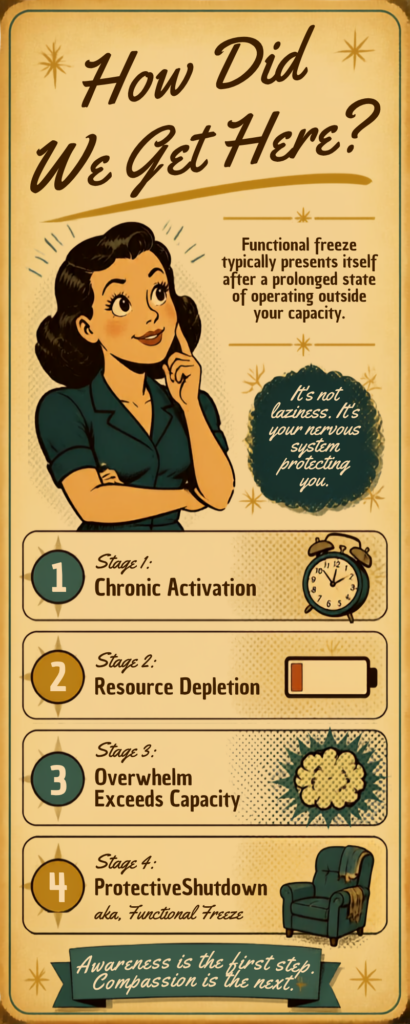
Functional freeze typically presents itself after a prolonged state of operating outside your capacity. It’s not something we experience overnight, but rather a gradual lessening of our ability to connect and be present in our life and experiences. This is also why it can be difficult for folks to observe in themselves – because it tends to be a slow burn over a sustained period. When we consider what factors may contribute to a person experiencing functional freeze, it’s helpful to view the process as an accumulating effect – often observed in stages.
Stage 1: Chronic Activation
This often starts with prolonged exposure or balancing of high-stress events or experiences. Think balancing a demanding career, parenting (especially if faced with behavioral/mental health/physical challenges), unexpected financial concerns or family stressors, relationship difficulties – all happening at once. Can also include:
- Constant responsibility
- High expectations at work or at home (or both)
- Caregiving demands (from both children and aging parents)
- Financial pressure or insecurity
- Persistent hypervigilance
- Perfectionism
Stage 2: Resource Depletion
Over time, though, we start to deplete the internal resources we’ve developed to keep going under the high demands. Warning signs that your resources may be starting to dwindle:
- Increased irritability
- Insomnia or hypersomnia (too much or too little sleep)
- Brain fog/difficulty concentrating
- Ongoing struggles with procrastination
- More emotionally dysregulated or reactive
- Reduced desire or enjoyment in things that usually bring enjoyment or pleasure
Many times, at this juncture, we naturally try to push even harder as we start to observe ourselves as not being able to “handle” it all. This is counterintuitive as it perpetuates more stress, which leads to our nervous system doubling down on keeping us safe and conserving our energy.
Stage 3: Overwhelm Exceeds Capacity
At this point, every day, menial tasks begin to feel inordinately difficult to keep up with. Things that we used to be able to do with ease now feel burdensome and nearly impossible. This may include completing tasks such as returning emails, scheduling and attending appointments, making decisions, keeping up with bills, and general written tasks. At this point, many folks begin to feel frustrated and angry with themselves as they recognize that they are struggling with things that “should” be easy for them. This, again, serves to perpetuate stress as we are now attacking our sense of self – which, you guessed it, forces our nervous system even farther into shutdown.
Stage 4: Protective Shutdown aka, Functional Freeze
After trying so hard to warn us, now our nervous system shifts fully down into shutdown mode as a means of conservation and survival. Whereas in the past we may have been able to use the Fight mechanism (solve the problem) or the Flight mechanism (escape the problem), we are now involuntarily using the Freeze mechanism. This looks like:
- Reduced initiative
- Mental fog
- Emotional numbing
- Avoidance (which can also look like social isolation)
- Difficulty starting or finishing tasks
- Feeling disconnected from motivation and interest
- General forgetfulness and confusion
That covers the freeze part – but we’ve neglected the functional component. Here, you may still be showing up to work, completing necessary tasks, taking care of your children and your household. The difference is that it is taking every ounce of energy to do just those basic things. Everything feels dire, and you never feel like you are recovering from one day to the next. To make things worse, because you are keeping it “together” externally, others may not even recognize that you are barely managing to stay the course. This fatigue, along with a general disinterested disposition, encapsulates the functional freeze experience.
The Window of Tolerance – Empowerment Through Awareness
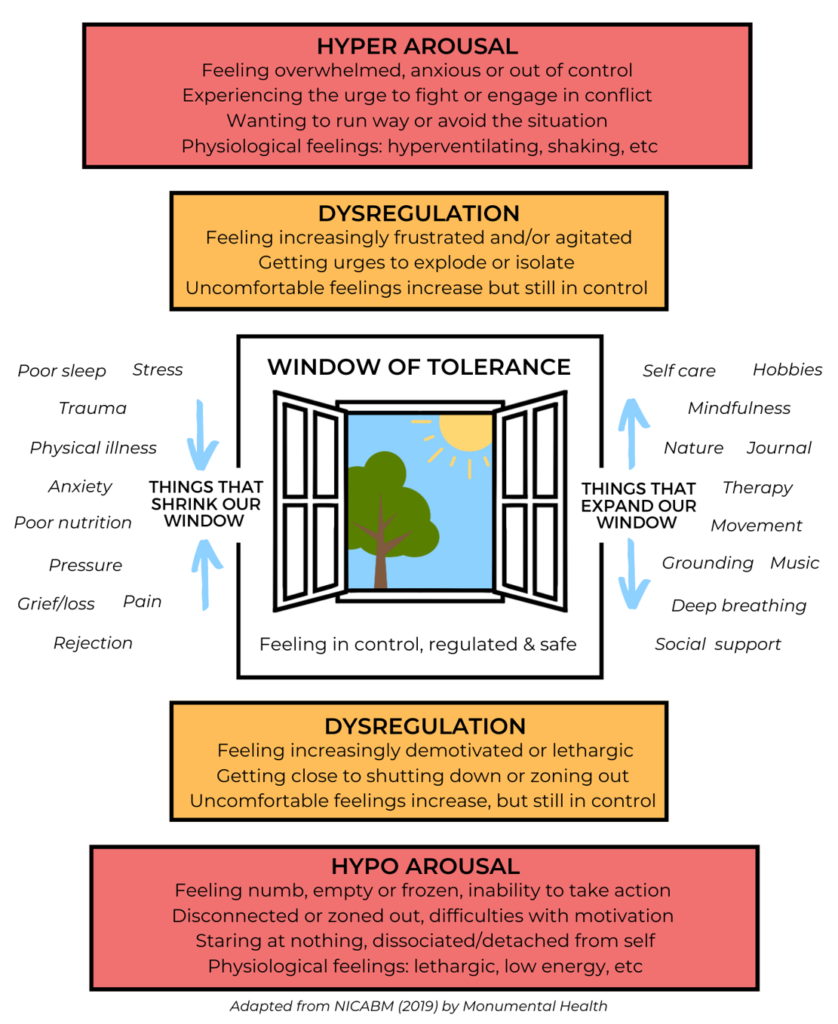
If you’re more of a visual person, the below image may help you better grasp the process of slipping into functional freeze. Many folks who have relied on their anxiety to keep them going have existed in the space occupying a state of Hyperarousal – either in the dysregulated state or in a full state of Hyperarousal. Oftentimes, we find ways to harness this energy state to move us towards our problems. Thus, it is not often regarded as problematic initially.
Our nervous system is not designed to remain in this hyper-aroused state indefinitely – no matter how much we would like it too. After a sustained period here, our nervous system will naturally use its own brake mechanism to let us know that we need to slow down. It’s not optional at this point; it is truly a means of survival.
As you can see at the bottom of the window of tolerance, this is where the freeze response steps in for the energy-conserving process and, ultimately, to keep us alive. This can be incredibly frustrating and disorienting for a person who has lived most of their life functioning from that hyper-aroused state. Not only can it feel like things are slipping away without resolution or completion, but your own sense of self can feel shaky as you have become so identified with being the person that can handle it all.
It might also be helpful to reference the things that both push us out of our window of tolerance as well as the things that help us to widen what we can tolerate. As we explore what to “do” when we recognize we are in functional freeze, the suggestions on the right side of the window – the things that can help our window grow – may be a helpful reference.
How Do We Get Unstuck
Naturally, your next question may be – okay, but what do I do about this?
First, I want to emphasize the importance of bringing awareness to the fact that you are in a functional freeze state in and of itself. The awareness, though it may feel menial, is half the battle towards feeling more like ourselves.
I want to caution here that our instinct to problem-solve this concern with more things “to do” can be counterproductive here. When we recognize that something is wrong, the first thing I do to frame a solution for clients is asking: Is this the time we need to add more or lessen our load?
Typically, when we recognize we are operating from a functional freeze nervous system state, the answer lies in doing less, not more. So, in practice – this may mean taking an honest assessment of our current demands and identifying what is perpetuating a sense of threat and what we can remove to increase a sense of safety and predictability.
Some Things to Consider
- Reduce your sense of urgency
- When we are in functional freeze, everything feels urgent. This sense that we are always needing to finish something, optimize our time, worry about missing something is causing our nervous system to overreact. Slow down.
- Break larger tasks down into smaller, more manageable tasks
- Instead of cleaning the whole house, let’s tackle the dishes. Do one load of laundry instead of all 4 loads.
- Outsource
- This is where we call in reinforcements. Can we hire a cleaner to come pick up the slack around the house? Can we take our friends/family/partners up on the offer of helping – the offer we usually turn down? Can we not take on additional commitments outside of work and family for a season? Can we use HEB delivery instead of going to the grocery store ourselves?
- Focus on regulating your body before regulating your mind
- Any type of physical exercise – walking, yoga, cardio, dancing
- Body scan meditations – these are my favorite, even for people who have never done a meditation before
- Being in low-stimulating environments – at the beach, in nature, in a room with the lights off and low noise
- Notice your inner critic
- Naturally, when we start slowing down, the voice that tells us we aren’t doing enough will turn the volume up. Notice this, acknowledge where it’s coming from, and choose that now is the time not to listen. Therapy can really support this process
- Reconnect with your values
- Many times, we have committed ourselves to things without understanding our “why.” This can lead to both burnout and an eventual experience of functional freeze. Therapy, again, can help support understanding your values as well as how to operationalize them in your life.
If reading this felt like someone finally described what’s been happening inside you, that recognition is the first step—and you don’t have to figure out the rest alone. You don’t need a plan or the “right words.” Just reach out at cady@oakspllc.com and we’ll start small, together. You can also follow along on Instagram @therapywithcady
 About Me
I’m Cady Parliman, LCSW-S, a Licensed Clinical Social Worker with over 10 years of experience specializing in complex and relational trauma, high-functioning anxiety and depression, and relationship issues, bringing expertise from my role as former Clinical Director of a PHP/IOP program in The Woodlands, TX. I am EMDR trained and use a personalized, trauma-informed approach grounded in the therapeutic relationship, integrating Person-Centered, CBT, DBT, and ACT modalities to help clients heal from past traumas and build fulfilling lives.